
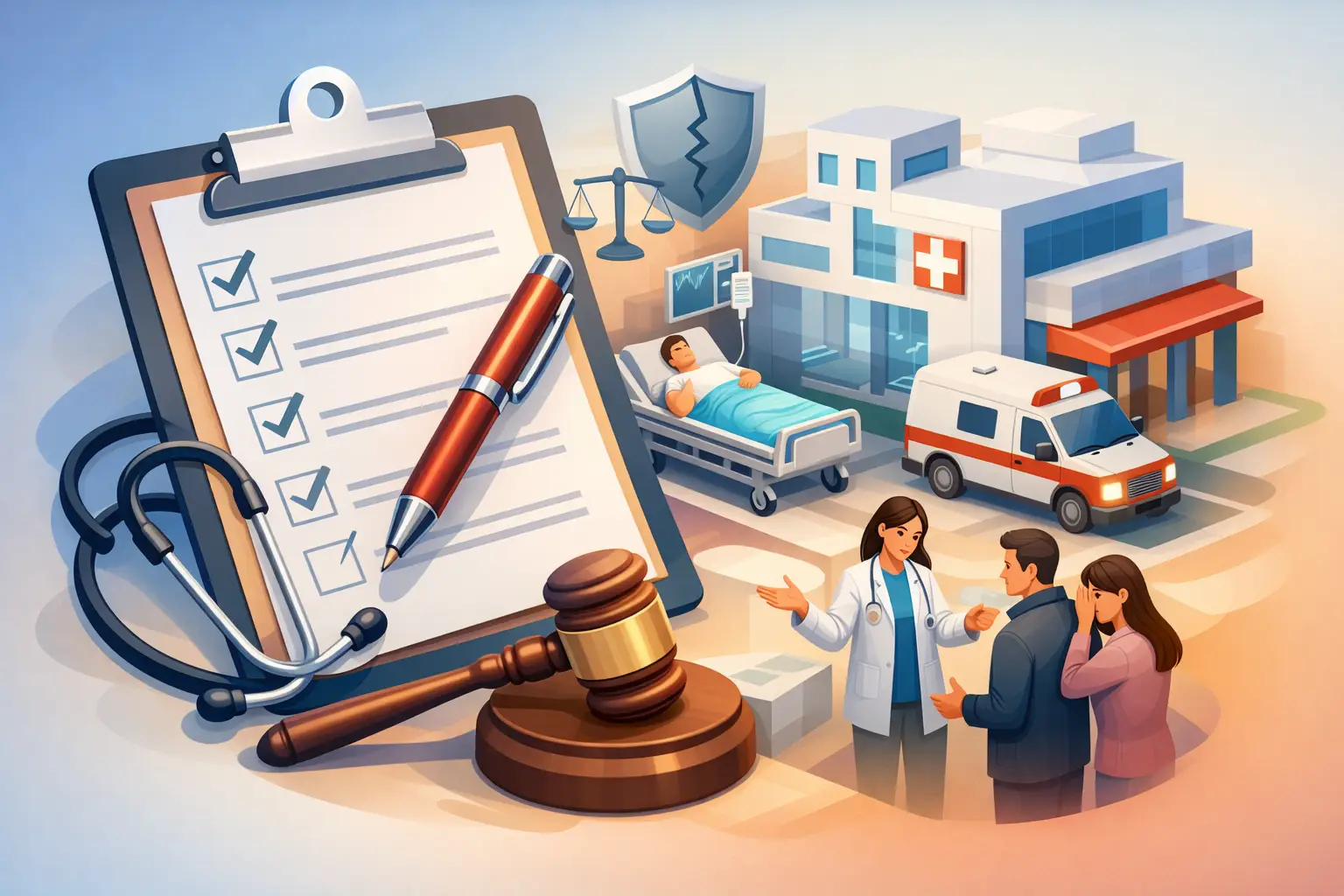
Hospital Negligence Claim Checklist
A bad outcome in a hospital does not always mean malpractice. But when a doctor ignores symptoms, a nurse gives the wrong medication, or a discharge decision puts a patient back in danger, the stakes are real. A strong hospital negligence claim checklist helps you separate suspicion from proof and take the right steps before critical evidence disappears.
Hospitals move fast when something goes wrong. Records get updated. Internal reviews start. Staff members protect their version of events. If you are the patient or a family member, you need a clear plan early. That does not mean accusing everyone in sight. It means preserving facts, identifying warning signs, and understanding whether the harm points to negligence rather than an unavoidable complication.
What a hospital negligence claim checklist should help you answer
At its core, a hospital negligence claim checklist asks four hard questions. Was there a duty of care? Did a hospital provider or employee breach that duty? Did that failure cause actual harm? And can that harm be proved with records, timelines, witnesses, and expert review?
Those questions sound simple. In real cases, they are not. A patient may already be very sick before admission. Multiple doctors may be involved. Some errors are obvious, such as treatment on the wrong body part. Others are more technical, such as a delayed response to sepsis, a failure to monitor oxygen levels, or a missed change in lab values that should have triggered intervention.
That is why a checklist matters. It keeps the case grounded in evidence instead of emotion alone.
Hospital negligence claim checklist: the facts to gather first
Start with the timeline. Write down when the patient arrived, what symptoms were reported, what treatment was given, and when the condition worsened. Include conversations that stand out, especially any statement that a symptom was “normal” when it later turned out to be serious. Memory fades fast, and hospital cases often turn on timing.
Next, gather all available records. That includes admission paperwork, discharge instructions, medication lists, lab results, imaging reports, surgical consent forms, follow-up recommendations, and billing records. If you have photos of visible injuries, medication labels, bruising, infections, or surgical sites, preserve them. If family members were present, ask them to write down what they saw while it is still fresh.
You should also note every provider involved, even if you are not sure who made the mistake. In many hospital cases, liability depends on whether the negligent person was a hospital employee, a contractor, a specialist, or part of a larger care team. Names, badges, departments, and shift times can matter later.
Signs the hospital may have breached the standard of care
A poor bedside manner is not malpractice. A bad result alone is not enough either. The question is whether the care fell below what a reasonably competent provider or hospital should have done under similar circumstances.
Common red flags include a failure to diagnose or respond to an emergency, medication errors, anesthesia mistakes, surgical mistakes, infections tied to poor protocols, falls caused by ignored safety precautions, and discharge decisions that no careful provider should have made. Birth injury cases may involve fetal distress that was missed or not acted on quickly enough. In other cases, alarms were ignored, test results sat unread, or a specialist consult was delayed for no good reason.
It also matters whether the hospital had systems in place and whether staff followed them. Some cases are about one provider’s mistake. Others are about breakdowns in staffing, communication, charting, supervision, or handoff procedures. If several small failures lined up and the patient paid the price, that can still be negligence.
Causation is where many cases are won or lost
Even when a mistake looks clear, you still have to connect it to the injury. That is often the hardest part of any hospital negligence claim checklist.
For example, if a patient was already in critical condition, the defense may argue the outcome would have happened anyway. If treatment was delayed, they may claim the delay made no difference. If an infection developed after surgery, they may say it was a known risk rather than proof of substandard care.
That is why details matter. Did the patient deteriorate after the wrong medication? Did a missed test result allow a stroke, rupture, or infection to advance untreated? Did a delayed C-section lead to oxygen deprivation? Did earlier intervention likely change the outcome? A trial-ready case needs evidence that the negligence was not just present but harmful.
Damages belong on every checklist
A valid claim also requires measurable losses. That includes added medical bills, corrective treatment, lost income, long-term disability, pain, and the human cost of a worsened condition. In fatal cases, surviving family members may face a wrongful death claim tied to hospital negligence.
Do not underestimate future harm. A patient may leave the hospital alive but with permanent nerve damage, brain injury, mobility loss, chronic infection, or the need for lifelong care. If the injury changed the person’s ability to work, live independently, or care for family, that should be documented early and thoroughly.
Keep receipts, insurance statements, wage information, and notes about daily limitations. Practical evidence is persuasive. It shows how the error changed real life, not just what appears in a chart.
Deadlines and procedural rules can hurt a good case
New Mexico medical negligence claims are controlled by deadlines and procedural requirements that can become traps if you wait too long. The exact timeline can depend on who provided the care and whether special rules apply. Government-run facilities, public providers, and certain entities may trigger notice requirements or shorter timelines.
That is one reason not to rely on a general internet checklist alone. You may have a serious case and still lose leverage if key deadlines pass, records are not requested, or the wrong party is identified early on.
In hospital litigation, timing is strategy. Waiting usually helps the defense.
When to talk to a lawyer instead of gathering more on your own
If the patient suffered catastrophic injury, died unexpectedly, was sent home too soon, received the wrong medication or procedure, or experienced a major delay in diagnosis or treatment, it is time to get legal eyes on the case. The same is true if the hospital is suddenly hard to reach, records seem incomplete, or staff members give conflicting explanations.
A serious malpractice lawyer does more than file paperwork. The right attorney builds the timeline, secures records, works with qualified medical experts, identifies every liable party, and prepares the case as if it may be tried. That matters. Hospitals and insurers evaluate risk differently when they know the lawyer on the other side is ready for court.
Bowles Law Firm is built for high-stakes litigation, with lead counsel experience in more than 88 trials and more than 40 appeals across federal, state, and military courts. If your case involves severe injury or loss, courtroom readiness is not a slogan. It is protection.
A practical hospital negligence claim checklist for families
If you need a working checklist, focus on these questions. What exactly happened, and when? Who made the key treatment decisions? What records, photos, discharge papers, and medication information do you already have? What injury followed, and what treatment was required because of it? How has the harm affected work, daily life, and future care? Has anyone from the hospital admitted an error, changed their explanation, or asked you to sign anything?
Also ask what you do not know yet. Missing gaps in the timeline often point to the next critical record or witness. A family member’s notes, a text message sent from the hospital room, or a pharmacy printout can become important pieces later.
You do not need to prove the whole case before calling a lawyer. You do need to protect what exists now.
What not to do after suspected hospital negligence
Do not assume the chart tells the full story. Do not post detailed accusations online. Do not sign releases or settlement papers without understanding the consequences. And do not let a reassuring phone call from a claims representative convince you the matter is being handled fairly behind the scenes.
Hospitals and insurers defend these claims aggressively. They know which facts matter and which gaps can weaken your position. You need the same level of discipline on your side.
If you believe a hospital’s mistake caused serious harm, act while the evidence is still fresh. Request a free case review, get the records in motion, and ask direct questions about whether the facts support a medical malpractice claim. A checklist is a starting point. Accountability takes action.