Who Pays After Fatal Crash Claims?
A fatal collision leaves a family with grief, shock, and a hard financial question that shows up fast: who pays after fatal crash losses. The answer is rarely simple. Medical bills may already exist before death. Funeral costs arrive quickly. Income may disappear overnight. And while insurance is usually the first place compensation comes from, it is not always the only place.
If your family is facing this in New Mexico, the key is to understand that payment depends on fault, available insurance, the type of claim being made, and whether a lawsuit is necessary. The facts matter. The policy limits matter. The timing matters.
Who pays after fatal crash losses in New Mexico?
In most cases, the at-fault driver’s auto insurance is the first source of compensation. If a driver caused the crash through speeding, distraction, impairment, reckless driving, or another negligent act, that driver’s bodily injury liability coverage may pay for wrongful death damages up to the policy limits.
That is the straightforward version. Real cases are often harder than that.
Sometimes multiple vehicles are involved, and more than one driver may share fault. Sometimes the driver who caused the crash was working at the time, which can bring in a commercial policy and an employer. Sometimes a dangerous road condition or defective vehicle part played a role. In those cases, payment may come from more than one source.
There are also cases where the at-fault driver has little insurance or no insurance at all. Then the family may need to look at uninsured or underinsured motorist coverage, umbrella coverage, or a claim against other legally responsible parties.
The usual sources of compensation after a deadly crash
Insurance is where most fatal crash claims begin. A personal auto policy may cover the driver who caused the collision. If that driver was on the job, a business policy may apply too. Commercial trucking cases often involve larger policies, but they also bring tougher defense tactics and faster evidence fights.
The deceased person’s own insurance can matter as well. Uninsured motorist or underinsured motorist coverage may help if the responsible driver did not carry enough coverage. Medical payments coverage may address some expenses regardless of fault, though the amount is usually limited.
In some cases, a claim may be made against an estate. If the at-fault driver died in the same crash, that does not automatically end responsibility. A wrongful death or survival-related claim can sometimes proceed through that driver’s estate and any available insurance tied to the loss.
When the facts support it, payment can also come from a company, a vehicle owner, a bar or business in limited circumstances, or a manufacturer. Those claims require careful investigation and usually face immediate resistance. That is where trial-ready legal work matters.
Wrongful death claim or estate claim?
Families often hear two terms after a fatal collision: wrongful death claim and estate claim. They are related, but they are not the same.
A wrongful death claim is brought on behalf of certain surviving family members under New Mexico law. It seeks compensation for the losses caused by the death itself. That can include the value of the life lost to the family, lost financial support, and other damages allowed by law.
An estate-based claim deals with losses the deceased person suffered before death, such as medical expenses, conscious pain and suffering in some cases, and other damages that belong to the estate rather than directly to surviving relatives.
Why does this matter? Because who receives compensation and what damages are recoverable may depend on which claim is being pursued. A family can lose ground quickly if these issues are handled casually.
What damages can be paid after a fatal crash?
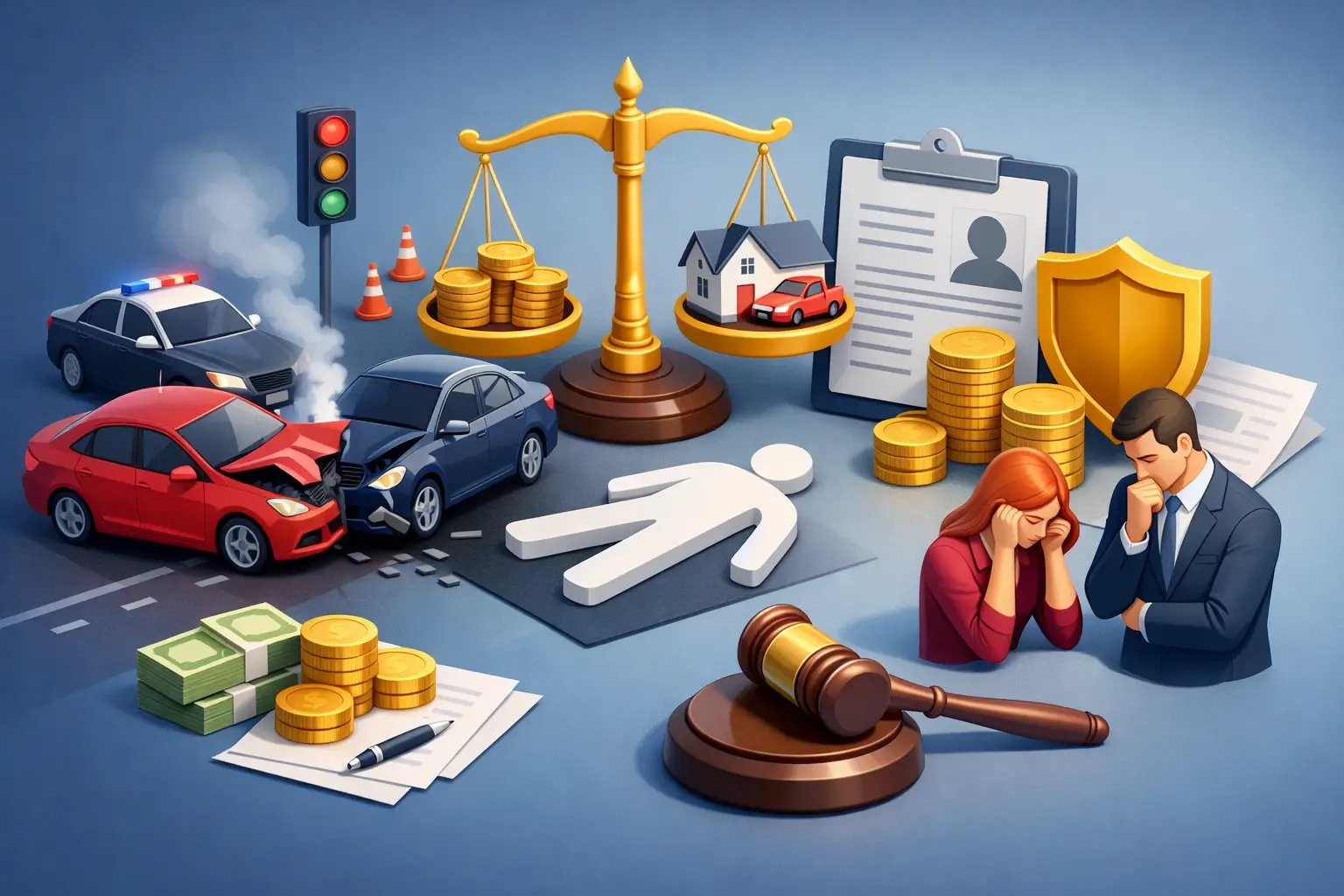
The bills people think of first are funeral and burial expenses, but they are only part of the picture. A fatal crash can create major medical bills from emergency treatment before death. It can also erase years of expected earnings, benefits, and household support.
There are also human losses the law recognizes, even though no check can fix them. Depending on the facts and the claim, damages may include loss of guidance, loss of care, and the destruction of the relationship the family would have had if the crash had not happened.
In particularly reckless cases, punitive damages may also be at issue. Drunk driving fatalities are the clearest example. Those claims are not automatic, but when the conduct was extreme, the law may allow damages meant to punish and deter.
What if the driver who caused the crash has no money?
This is one of the hardest realities in fatal crash cases. A strong liability case does not always mean a strong recovery. If the at-fault driver carried only minimal insurance and has no significant assets, there may be a serious gap between the value of the case and what can actually be collected.
That does not mean the case is over. It means the investigation has to widen.
A serious lawyer will examine every possible source of recovery: additional insured parties, employer liability, vehicle ownership issues, commercial coverage, umbrella policies, uninsured and underinsured motorist coverage, and any third-party negligence that contributed to the crash. In fatal cases, missing one source of coverage can cost a family dearly.
How fault affects who pays after fatal crash cases
Fault is central, but it is not always all-or-nothing. New Mexico follows a comparative fault system, which means responsibility can be divided among multiple parties. If more than one person contributed to the collision, payment may be split according to each party’s share of fault.
That matters because insurance companies often try to reduce exposure by shifting blame to the deceased person or to someone else involved in the crash. They may argue the deceased was speeding, not wearing a seatbelt, made an unsafe turn, or could have avoided the impact.
Those arguments are not just about narrative. They are about money. The more fault they can place elsewhere, the less they may have to pay. That is why early investigation matters. Skid marks fade. Vehicles get repaired or destroyed. Electronic data disappears. Witness memories soften.
Why these cases are fought hard
Fatal crash claims are high-stakes cases. When a family’s wage earner is killed, or when the facts suggest gross negligence, the financial exposure can be significant. Insurers know that. Defense lawyers know that. They often move fast to control the story, limit admissions, and protect the policy.
Families should do the same. That means preserving evidence, identifying all available insurance, avoiding recorded statements without legal advice, and getting a clear case evaluation early.
This is also why courtroom experience matters. Some claims settle fairly because the other side knows the case is prepared for trial. Others only move when they understand a verdict is a real possibility. A firm built around litigation, not quick volume settlements, approaches fatal crash cases differently.
What families should do in the first days and weeks
There is no perfect way to handle the first days after a fatal collision, especially while grieving. Still, a few decisions can protect the case.
Get the crash report and identify all drivers, owners, and insurers. Keep every bill, receipt, and record tied to the death. Do not sign releases or accept a quick settlement before the full picture is known. If a vehicle defect, commercial driver, or intoxicated driver may be involved, act quickly to preserve evidence.
If you are getting calls from insurers, that does not mean they are there to protect your family. Their job is to resolve claims for as little as possible within the law.
When to talk to a wrongful death lawyer
Immediately is the right answer in most fatal crash cases. Not because every case must be filed in court right away, but because the value of the claim often depends on evidence that can disappear fast.
An experienced trial lawyer can determine who may be legally responsible, what insurance applies, whether an estate issue is involved, and what damages should be pursued. Just as important, your family gets a buffer between your grief and the pressure tactics that often follow a deadly wreck.
Bowles Law Firm handles high-stakes injury and wrongful death litigation with the trial focus these cases demand. If your family is asking who pays after fatal crash losses, Call Now or Request Free Case Review before evidence disappears and the insurance companies set the terms.
No family gets a second chance to build this case the right way. The money issue is not the whole story, but it does shape what comes next for the people left behind. Get answers early, protect the evidence, and make sure the case is prepared like it may have to be won in court.