
Best Evidence After Truck Crash Cases
A truck crash case can turn on a few pieces of proof that disappear fast. The best evidence after truck crash collisions is often collected in the first hours or days, not months later when memories fade, vehicles are repaired, and electronic data is overwritten. If you were hit by a semi-truck, delivery truck, or other commercial vehicle, what you preserve right now can shape whether the insurance company takes your claim seriously.
Truck cases are not ordinary fender-benders. A commercial carrier may have a defense team, insurer, safety department, and investigators working early to control the narrative. That is why the strongest cases are built on hard evidence, not guesswork.
What counts as the best evidence after truck crash claims?
The best evidence after truck crash claims usually falls into two categories: proof of how the wreck happened and proof of what the wreck cost you. You need both. Liability evidence shows who caused the crash. Damages evidence shows why the claim has real value.
In a truck collision, liability proof can include the police report, photos of vehicle damage, skid marks, debris fields, surveillance video, dashcam footage, witness statements, black box data, driver logs, inspection records, and maintenance records. Damages proof often includes emergency room records, imaging studies, surgical records, physical therapy notes, wage-loss documentation, and evidence of future medical needs.
Not every case will have every type of proof. Sometimes a crash happens on a quiet road with no camera footage. Sometimes the police report gets key facts wrong. Sometimes witnesses vanish. A strong lawyer looks at what is available, what can still be preserved, and what needs to be challenged.
The evidence that disappears first
Some proof is durable. A broken bone shown on an MRI is still a broken bone six months later. Other proof is fragile. Electronic logging data, onboard computer information, dispatch records, text communications, and nearby video footage may be deleted or lost unless someone acts quickly.
That is one reason truck cases often demand faster legal action than people expect. Commercial trucks can carry event data recorders and other electronic systems that capture speed, braking, steering input, and hours of service. But companies do not always preserve that data forever. Video from businesses near the crash scene may also be recorded over within days.
This is where delay hurts. If you wait too long, the case may come down to your word against the truck driver’s version. That is a much weaker place to start than a case backed by physical evidence and digital records.
Scene evidence can make or break liability
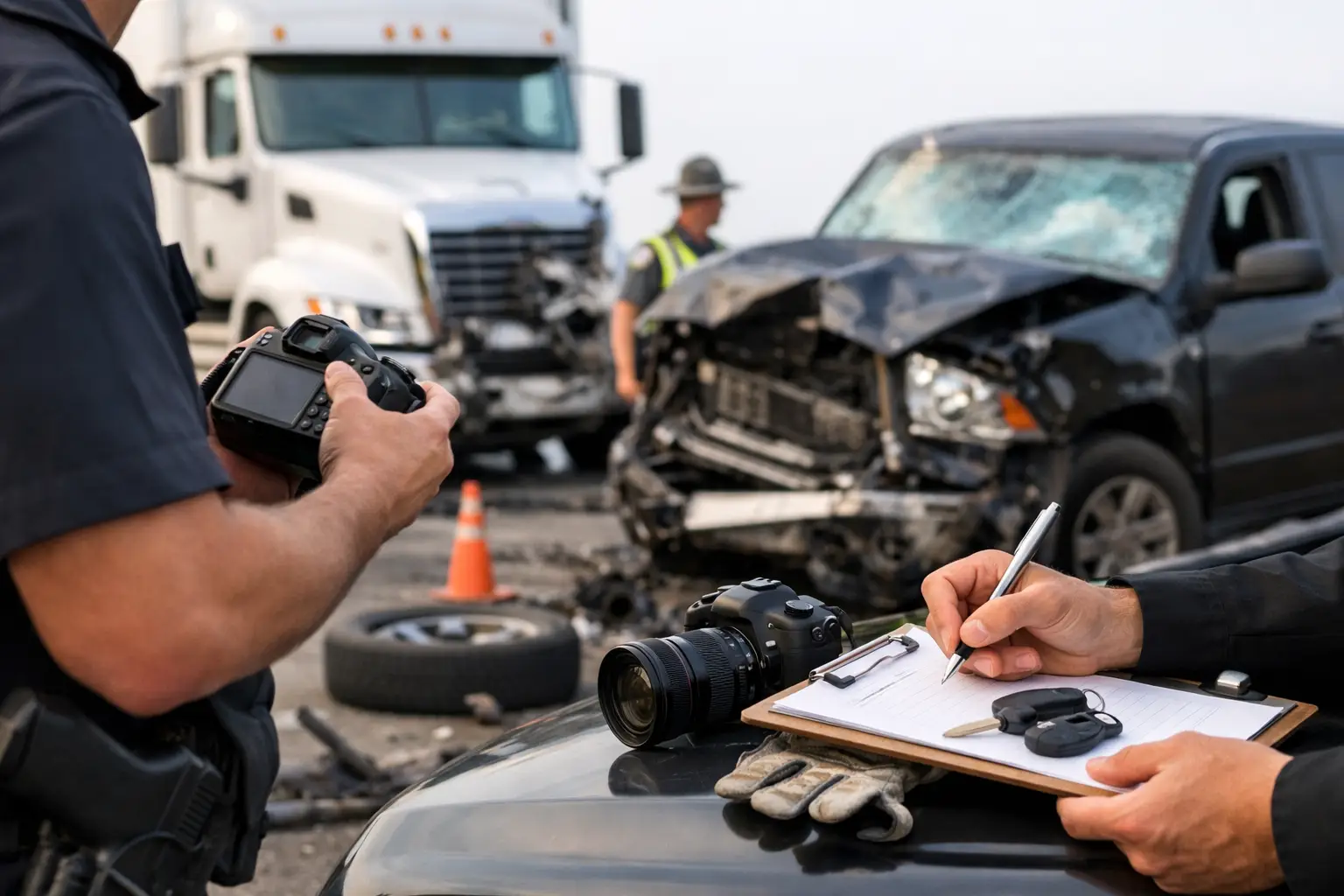
Photos and video from the crash scene are often more powerful than people realize. Wide shots show lane positions, traffic controls, weather, and sight lines. Close-ups show impact points, crushed metal, shattered glass, tire marks, gouge marks in the pavement, and cargo spill patterns. Together, those details can help accident reconstruction experts determine speed, angle of impact, braking, and who crossed into whose path.
If you are physically able after the crash, take photographs before vehicles are moved. If you cannot, ask a family member or trusted person to return as soon as possible. Focus on the road, intersections, signage, shoulder conditions, and any obstructions. Trucking cases are often defended aggressively, and small details matter.
The vehicles themselves are also evidence. The damage pattern on your car and the truck can tell a story that words alone cannot. Do not rush to repair, destroy, or dispose of a damaged vehicle without getting legal advice if serious injuries are involved.
Why electronic data matters in truck cases
Commercial trucking generates records. That is one reason these cases can be stronger than ordinary car wreck cases when handled correctly. A truck driver may be subject to hours-of-service rules, inspection requirements, maintenance schedules, dispatch communications, and company safety policies. Those records may reveal fatigue, skipped inspections, overloaded cargo, poor maintenance, speeding, or pressure from the company to keep driving.
Black box and telematics data can show whether the truck braked late, accelerated before impact, or was traveling faster than claimed. Driver qualification files may reveal training issues or a poor safety history. Cell phone records can help show distraction. Post-crash drug and alcohol testing may also matter depending on the facts.
This is not evidence an injured person can usually gather alone. It often requires formal preservation demands and litigation strategy. A trial-tested attorney knows what to request, what deadlines matter, and how to spot gaps in what the company produces.
Medical records are not just paperwork
Many injured people assume liability is the whole case. It is not. Even if fault seems obvious, the insurer will still attack the seriousness of your injuries, the timing of treatment, and whether the crash actually caused your condition. That is why your medical evidence matters just as much as the crash evidence.
Get evaluated promptly. Follow through with treatment. Tell your doctors where you hurt, how the symptoms started, and how your daily life changed. Gaps in care can be used against you. So can vague complaints that never make it into the chart.
Good medical proof does more than confirm an injury exists. It connects the wreck to the diagnosis, explains why treatment was necessary, and documents whether you are expected to recover fully or live with long-term limitations. In serious truck crash cases, future damages are often substantial. Those claims need support from treating providers and, in some cases, expert testimony.
Witnesses help, but they are not enough by themselves
Independent witnesses can be very helpful, especially when they have no connection to either driver. A neutral witness who saw the truck drift lanes, run a red light, or make a wide turn into traffic can strengthen a case immediately.
Still, witness testimony has limits. People forget details. They mix up timing. They may leave before police arrive. That is why names, phone numbers, and recorded statements matter early. A witness is strongest when their account is backed by physical evidence, video, or vehicle data.
The police report matters, but it is not the final word
Many people put too much weight on the police report. It is important, but it is not perfect. Officers usually arrive after the impact, not before it. They may rely on quick statements from shaken drivers and incomplete scene information. In a truck case, later investigation can uncover facts the initial report missed.
If the report supports your account, that helps. If it contains errors, do not assume the case is lost. The real question is whether stronger evidence exists to prove what happened.
Mistakes that weaken evidence after a truck crash
The most common mistakes are delay, inconsistency, and silence. Waiting too long to get treatment, posting casually on social media, failing to document symptoms, speaking to the trucking insurer without preparation, or allowing key records to disappear can all damage a valid claim.
Another mistake is assuming the trucking company will preserve what is fair. Sometimes it will. Sometimes it will not. Serious injury cases should be approached like litigation from the start, because that may be where they end up.
What to do right away to protect your case
If you can do so safely, photograph the scene, the vehicles, your injuries, and anything that may explain the crash. Get witness contact information. Seek medical care quickly. Keep discharge papers, bills, prescriptions, and work-loss records. Save communications from insurers. Avoid guessing about fault or minimizing your injuries.
Then get legal counsel involved early. In a serious commercial truck case, early intervention can mean the difference between preserved evidence and lost evidence. It can also stop the insurance company from controlling the pace of the claim while you are still trying to recover.
At Bowles Law Firm, that early case-building mindset matters. Serious cases are prepared with trial in mind, not just settlement talk. When the other side knows your lawyer is ready to prove the case in court, the evidence carries more weight.
Truck crashes leave more than vehicle damage. They disrupt work, health, family life, and financial stability. The right evidence can bring clarity to a chaotic event and put real pressure on the people responsible. If you believe a truck driver or trucking company caused serious harm, call now or request a free case review before critical proof is gone.