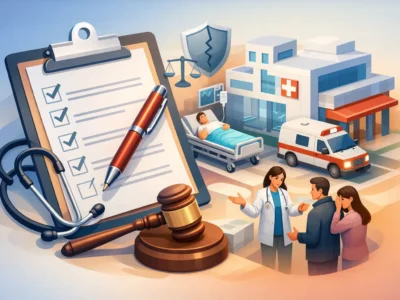

Medical Negligence Trial Verdict Example
A medical negligence trial verdict example is not a promise of what any injured patient will recover. It is a practical way to see what a jury must decide when a trusted medical professional’s mistake leaves someone facing permanent harm, lost income, or the death of a family member. The verdict turns on proof, not outrage alone. A serious injury can support a serious case, but the evidence must show that negligent care caused it.
For New Mexico patients and families, understanding how a case reaches a jury matters. Hospitals, physicians, insurers, and their defense lawyers do not evaluate claims based only on sympathy. They examine records, timelines, expert opinions, prior health conditions, and every gap they can find. A lawyer preparing for trial must do the same work, earlier and more thoroughly.
A Medical Negligence Trial Verdict Example: Delayed Diagnosis
Consider a hypothetical case involving a 46-year-old Albuquerque patient who visited an emergency department twice in three days with escalating chest pain, shortness of breath, and sweating. On the first visit, a physician ordered an EKG and blood work. The EKG contained findings that, according to the patient’s medical expert, required immediate cardiology consultation and repeat testing. The physician documented the symptoms as anxiety, discharged the patient, and instructed her to follow up with her primary care provider.
The patient returned two days later after collapsing at home. She had suffered a major heart attack and underwent emergency treatment. She survived, but her heart function was permanently reduced. She could no longer perform the physical duties of her job and required ongoing cardiac care.
At trial, the patient alleged that the emergency physician failed to meet the accepted standard of care by missing warning signs of a developing cardiac event. The defense argued that the original test results were not definitive, that the patient had risk factors unrelated to the physician’s decisions, and that an earlier admission may not have changed the outcome.
After hearing testimony from emergency medicine and cardiology experts, reviewing the records, and considering economic and medical damages, the jury returned a verdict for the patient. The award included past medical expenses, anticipated future care, lost earnings, reduced earning capacity, and compensation for pain and suffering.
That result did not follow automatically from the heart attack. The case succeeded because the evidence connected four necessary points: what the physician should have done, what the physician actually did, how that departure affected the patient’s medical outcome, and what the harm cost the patient and her family.
What the Jury Must Decide
A medical negligence trial is not a referendum on whether a provider was kind, respected, or generally competent. A jury focuses on the specific care at issue. In New Mexico, the injured party generally must prove that the provider owed a duty of care, failed to meet the applicable professional standard, caused an injury, and produced compensable damages.
The standard of care is usually the central fight. Medicine involves judgment calls, and a poor outcome alone does not establish negligence. The question is whether a reasonably qualified provider, working under similar circumstances, would have recognized the danger and acted differently.
Causation can be even harder. Defense counsel may agree that a mistake occurred but argue that it did not change anything. In a delayed diagnosis case, for example, the defense may claim that the disease was already too advanced. In a surgical error case, it may argue that the complication was a known risk even when proper care is used. The plaintiff’s legal team must present qualified expert testimony that explains, in clear terms, how prompt and appropriate care would probably have prevented or reduced the harm.
Damages require their own proof. Bills and wage records matter, but they rarely tell the whole story. Permanent disability can affect mobility, sleep, independence, family responsibilities, and the ability to do meaningful work. A credible case presents the full human and financial consequence without exaggeration.
Evidence That Can Change the Verdict
Medical records are the foundation, but they are not always complete or reliable. Charts may contain copied language, late entries, conflicting times, or documentation that does not match the testimony of the people involved. A trial-ready lawyer scrutinizes the timeline instead of accepting the chart at face value.
In the hypothetical delayed-diagnosis case, the decisive evidence might include the original EKG, timestamps showing how long the patient waited, nursing notes describing symptoms, discharge instructions, pharmacy records, employer documentation, and testimony from family members who observed the decline. Each piece can either support or challenge the central medical narrative.
Expert witnesses often carry substantial weight. An expert must do more than state that they would have handled the case differently. Strong testimony identifies the accepted practice, applies it to the actual record, and explains why the lapse made a medical difference. Experts must also be prepared for rigorous cross-examination about their credentials, assumptions, prior testimony, and opinions.
Economic experts and life-care planners may be necessary where injuries create long-term needs. They can calculate projected care costs, lost benefits, and diminished earning capacity. Yet numbers must remain tied to evidence. Inflated claims give the defense an opening to question the entire case.
Why Similar Cases Can Produce Different Results
Two patients can suffer similar injuries and receive dramatically different verdicts. One case may have clear records, credible experts, and a direct timeline. Another may involve disputed symptoms, a complicated medical history, conflicting specialists, or evidence that the patient did not follow discharge instructions. These facts do not always defeat a claim, but they affect risk and value.
The venue also matters. Jurors bring their own life experience to questions of medicine, accountability, and damages. So do the legal instructions they receive from the judge. New Mexico’s laws governing medical malpractice claims, including rules affecting available damages and claims involving qualified healthcare providers, can influence how a case is evaluated and tried. A lawyer must analyze the facts under the law that applies when the claim arose, not rely on a headline about a verdict from another state.
Settlement posture matters as well. Many claims resolve before trial because both sides understand the risks of a jury verdict. But a fair settlement usually requires credible trial leverage. If an insurer believes the injured person’s lawyer is unprepared to take depositions, retain experts, challenge defense theories, and present the case to a jury, it has little reason to make a serious offer.
What Families Should Do Before a Claim Is Lost
Medical negligence cases are document-heavy and time-sensitive. A family dealing with a birth injury, medication error, surgical complication, missed diagnosis, or wrongful death should preserve what it can. Keep discharge papers, medication bottles, appointment records, receipts, photographs, and a written account of symptoms and conversations while memories are fresh.
Do not alter records or rely on a provider’s verbal explanation as the final answer. Requesting records is often an early step, but records alone do not reveal whether malpractice occurred. They must be reviewed in context by people who understand both the medicine and the courtroom burden of proof.
Avoid assuming that a provider’s apology proves a case, or that a provider’s denial ends one. The details matter. So do deadlines. Waiting can make it harder to locate witnesses, preserve evidence, and meet the legal requirements that apply to a claim.
A Verdict Is Built Long Before Trial
A compelling medical negligence case is built through disciplined investigation, not dramatic courtroom language. The legal team must identify the right experts, test the medical timeline, measure the long-term losses, and prepare for the defense’s strongest explanation before filing a claim or making a demand.
Bowles Law Firm approaches high-stakes litigation with the courtroom in mind. Jason Bowles has served as lead counsel in more than 88 trials and handled more than 40 appeals. That trial experience matters when a family needs direct answers about whether the facts can withstand scrutiny from a hospital’s defense team, a judge, and a jury.
If medical care caused serious harm, do not let uncertainty or a provider’s quick explanation decide the issue for you. Request a free case review, bring the records you have, and get a clear assessment of the evidence, the risks, and the next step worth taking.