
How to Handle Insurance Adjusters After a Crash
The call often comes before you have slept, seen every doctor, or even understood how badly you are hurt. The adjuster may sound concerned and helpful. But knowing how to handle insurance adjusters starts with recognizing their role: they work for the insurance company, and their job is to resolve claims for as little as the policy and the facts will allow.
After a serious Albuquerque car crash, a medical injury, or another event caused by someone else’s negligence, you do not need to make a rushed decision. You need accurate information, documented losses, and a strategy that protects your right to full compensation.
Understand What the Adjuster Is Trying to Learn
An insurance adjuster investigates the claim, evaluates fault, reviews coverage, and looks for information that may reduce what the insurer pays. That does not make every adjuster dishonest. It does mean you should treat every conversation as part of the claims process, not as a casual check-in.
Early questions often focus on the details that can later be used to dispute liability or minimize your injuries. You may be asked whether you are feeling better, whether you saw the other driver, whether you had a prior injury, or whether you could have avoided the collision. A simple answer given while you are in pain or under stress can be taken out of context later.
Be polite, but do not guess. Do not fill silence with speculation. If you do not know an answer, say so. If you are still receiving treatment, it is fair to explain that you are not ready to discuss the full extent of your injuries.
How to Handle Insurance Adjusters Without Hurting Your Claim
You generally should report a crash promptly to your own insurer, especially if your policy requires notice. Provide basic facts: when and where the event happened, the vehicles involved, and how to reach you. Beyond that, slow the process down enough to make informed choices.
Do not give a recorded statement without advice
Adjusters commonly request recorded statements. In some situations, your own policy may require cooperation, but that does not mean you must immediately provide a broad, unprepared statement to the other driver’s insurer. Before agreeing, understand who is asking, why they want the statement, and what your policy requires.
Recorded statements can lock you into incomplete details before the evidence is fully developed. This is especially risky in cases involving head injuries, back injuries, delayed symptoms, multiple vehicles, or disputed fault. A lawyer can help you respond appropriately while meeting legitimate policy obligations.
Keep the conversation factual and brief
Avoid statements such as “I am fine,” “I did not see them,” or “maybe it was partly my fault.” You may mean only that you are trying to be cooperative. The insurer may treat those words as evidence.
Instead, stick to confirmed facts. Give the claim number, identify the incident, and state that you are obtaining medical care or reviewing the situation. Do not discuss pain levels, diagnoses, missed work, prior medical history, or fault in detail until you understand the consequences.
Do not sign a broad medical release
The insurer may ask you to sign an authorization for medical records. Some release forms are far broader than necessary. They can permit the insurer to search years of unrelated medical history and argue that a current injury existed before the incident.
Your medical condition is relevant, but the insurer does not automatically need unrestricted access to every record from your life. Records should be gathered carefully and limited to what is reasonably related to the claim. This is one area where experienced legal guidance can prevent a major mistake.
Preserve evidence before it disappears
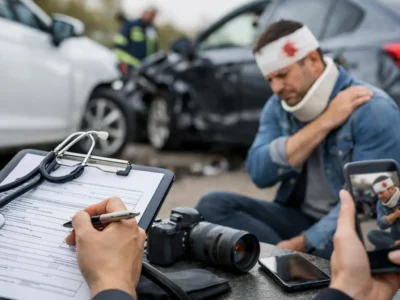
Photographs, damaged property, surveillance video, vehicle data, witness memories, and medical records can all matter. Take pictures of vehicles, the scene, visible injuries, and damaged personal items. Save repair estimates, receipts, discharge instructions, prescription records, and every letter or email from an insurer.
If you miss work, keep pay stubs and a written record of missed shifts, reduced hours, and job duties you could not perform. If pain affects sleep, mobility, household responsibilities, or family activities, document that too. A claim is not just a stack of bills. It is the real effect an injury has on your life.
Do Not Accept the First Settlement Offer Just to End the Calls
A quick settlement offer may feel like relief when bills are mounting. It may also arrive before you know whether treatment will be short-term or whether you will need surgery, therapy, specialists, or time away from work.
Once you sign a release, the case is usually over. You generally cannot return later for more money simply because your injuries proved more serious than expected. That is why settling before reaching a point of medical clarity can be a costly decision.
There are situations where an early settlement makes sense. Minor injuries may resolve quickly, liability may be clear, and the offer may fairly cover the documented losses. But a serious injury claim should be evaluated based on more than the emergency room bill. Future care, lost earning capacity, pain, physical limitations, and available insurance coverage all deserve careful review.
Be Careful With Your Own Insurance Company, Too
Many injured people assume their own insurer is automatically on their side. Your policy may provide valuable benefits, including medical payments coverage, uninsured motorist coverage, or underinsured motorist coverage. Those benefits can be essential when the at-fault driver has little or no insurance.
Still, your insurer may have financial interests that conflict with yours once you make a substantial claim. Read the policy, report the claim, and comply with reasonable requests, but do not assume that accepting the company’s evaluation is your only option.
New Mexico follows a comparative fault system. If an insurer can persuade a jury that you were partly responsible, it may try to reduce the value of the claim by your percentage of fault. That makes careful evidence collection and measured communication especially important. A disputed detail about speed, a turn signal, or what happened in the seconds before impact can become central to the case.
Watch for Tactics That Create Pressure
Insurance companies have deadlines, procedures, and settlement authority. They may use them to create urgency for you. An adjuster might say an offer will expire, suggest you do not need counsel, or imply that a claim cannot move forward unless you immediately provide a statement or sign paperwork.
Pressure is not proof that the offer is fair. Ask for all offers in writing. Ask what damages the offer includes. Ask whether it accounts for future treatment, lost income, and other available coverage. Then take the time needed to make a decision based on facts rather than fear.
Also, be cautious about social media. Photos, comments, and check-ins can be misread or selectively presented as evidence that your injuries are less serious than claimed. You do not have to stop living your life, but you should assume posts may be reviewed by the insurer.
When a Lawyer Should Take Over the Conversation
You should strongly consider speaking with a trial lawyer before dealing further with an adjuster if you suffered significant injuries, missed work, face ongoing treatment, lost a family member, or are being blamed for the incident. Legal help also matters when multiple parties are involved, coverage is unclear, the insurer denies responsibility, or the settlement offer does not come close to your losses.
A lawyer can investigate fault, preserve evidence, identify insurance policies, calculate damages, manage adjuster communications, and prepare the claim as though it may need to be tried. That preparation changes the posture of a case. Insurers assess risk, and they know the difference between a claim supported by evidence and one that is ready for courtroom scrutiny.
At Bowles Law Firm, serious cases receive direct, trial-focused attention grounded in extensive experience in federal, state, and appellate courts. If an insurer is minimizing your injuries or pushing you to settle before you are ready, request a free case review and get clear advice before you sign anything.
You do not have to win an argument with an adjuster on the phone. Protect the evidence, protect your words, and make sure any resolution reflects what the injury has actually taken from you.