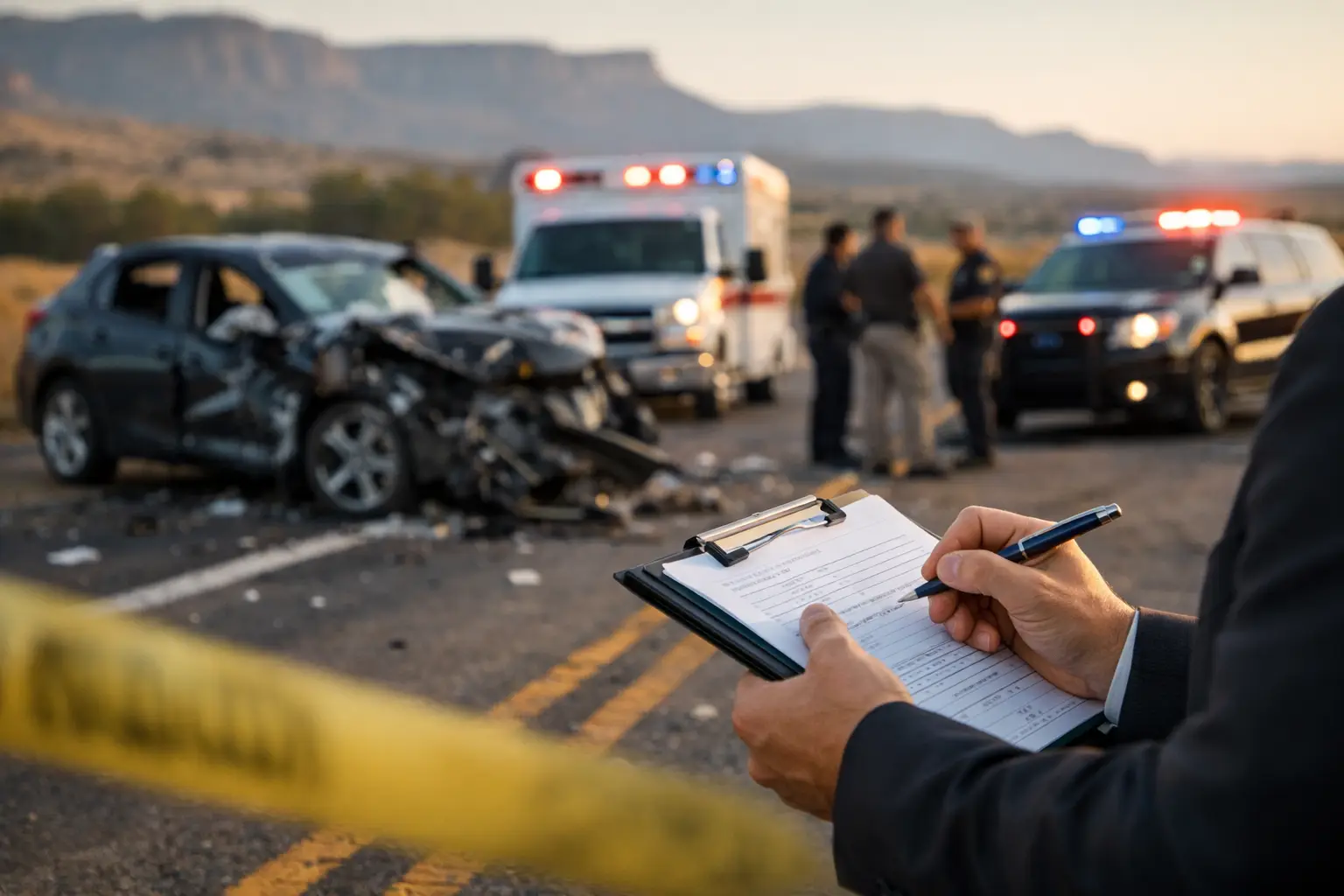
Best Steps After a Fatal Crash in New Mexico
A fatal crash changes the next hour, the next week, and the future of an entire family. In the confusion that follows, the best steps after fatal crash are not about having every answer immediately. They are about protecting your loved one’s rights, preserving evidence before it disappears, and refusing to let an insurance company define what happened.
For New Mexico families, a death caused by another driver’s carelessness, impairment, reckless conduct, or a dangerous roadway may support a wrongful death claim. That claim can provide financial accountability, but strong cases are built early. The decisions made in the days after the collision can affect the evidence available months later.
First, Let Law Enforcement and Medical Professionals Do Their Work
At the scene, call 911, accept emergency assistance, and follow instructions from police and first responders. Do not move vehicles or debris unless safety requires it. A collision involving a death will typically trigger a serious investigation, and officers may document vehicle positions, witness accounts, roadway conditions, signs of impairment, and other critical facts.
If you are a surviving family member arriving afterward, do not feel pressured to answer questions you do not understand. You can provide basic identifying information, but it is reasonable to say that you need time before discussing details. Grief and shock make it difficult to process information accurately.
Request the agency name, report number, and the contact information for the investigating officer when it is available. The initial police report matters, but it is not the final word on fault. Reports can omit witnesses, misunderstand vehicle movements, or fail to capture evidence that later proves decisive.
Best Steps After a Fatal Crash: Protect the Evidence
Evidence starts disappearing immediately. Skid marks fade, debris is cleared, vehicles are towed, surveillance video is overwritten, and witnesses return to their lives. A family should not have to conduct an investigation while mourning, but someone must act quickly to ensure key evidence is not lost.
If it can be done safely and without interfering with investigators, preserve photographs and video of the vehicles, roadway, weather, traffic signals, nearby businesses, visible injuries, and any damage to guardrails or signs. Save text messages, call logs, photos, and voicemails connected to the incident. Write down the names and contact information of anyone who saw the crash or arrived immediately afterward.
The vehicle itself can be vital evidence. Modern vehicles may contain crash data recorders that capture information such as speed, braking, steering input, seat belt use, and force of impact. Damage patterns can also reveal how the collision occurred. Do not authorize a vehicle’s repair, sale, or destruction before speaking with a qualified wrongful death attorney. The other driver’s vehicle may need to be preserved as well.
A lawyer can send formal preservation notices to insurers, towing companies, businesses, government agencies, and other parties that may possess evidence. Those notices can address vehicle data, dash camera footage, dispatch records, phone records, security video, maintenance documents, and other material that may not be available later.
Do Not Let an Insurer Rush the Family
The at-fault driver’s insurance company may contact the family quickly. Their representative may sound sympathetic, and there is nothing wrong with listening. But you are not required to give a recorded statement, sign medical releases, accept a settlement offer, or agree with an adjuster’s version of events.
Early offers frequently arrive before a family understands the full financial and personal loss. A fatal collision can involve final medical bills, funeral expenses, lost income, lost household support, and the loss of guidance and companionship. In some cases, the conduct that caused the crash may also warrant punitive damages.
Insurance companies investigate claims with their own financial interests in mind. Their goal is often to limit what they pay, not to make a family whole. Before signing anything, speak with counsel who is prepared to evaluate the evidence, identify all available insurance coverage, and take the case to court if a fair resolution is not offered.
Understand How Wrongful Death Claims Work in New Mexico
New Mexico wrongful death law has a structure that can surprise grieving families. The lawsuit is generally brought by a court-appointed personal representative for the deceased person’s estate. That person may be a spouse, adult child, parent, or another appropriate individual, depending on the circumstances.
The personal representative brings the claim for the benefit of statutory beneficiaries. Who receives any recovery and in what shares depends on the family relationships defined by New Mexico law. This is one reason families should obtain clear legal advice early rather than relying on assumptions about who has authority to act.
A wrongful death case is separate from any criminal investigation. If the other driver is arrested for DWI, vehicular homicide, reckless driving, or another offense, that may be significant evidence, but a criminal case does not automatically compensate the family. The standards of proof, procedures, and goals are different. Civil counsel can protect the family’s interests while criminal authorities pursue their own case.
Timing matters. Wrongful death claims are subject to legal deadlines, and claims involving a government entity or a dangerous public roadway can involve shorter notice requirements. Waiting for every report or every criminal proceeding to finish can put a civil claim at risk. Prompt legal review preserves options.
Look Beyond the Other Driver
The obvious question is often whether the other driver ran a red light, was speeding, or was impaired. That question matters, but a serious investigation should not stop there. Fatal crashes can involve more than one responsible party.
For example, a commercial driver may have been pressured to work beyond safe limits, a trucking company may have ignored maintenance problems, a bar may have unlawfully served an intoxicated driver, or a vehicle defect may have worsened an otherwise survivable collision. A dangerous intersection, poor road design, missing signage, or negligent construction zone management can also contribute to a fatal crash.
The facts determine which claims are viable. Expanding an investigation without evidence is not strategy. But failing to examine every credible source of fault can leave a family without the full accountability the law may allow.
Keep Records Without Trying to Carry the Case Alone
In the weeks ahead, create one organized file for crash-related documents. Keep the police report, incident number, medical and funeral bills, insurance letters, employment records, photographs, and notes from every call. Preserve receipts for travel, lodging, memorial expenses, and other costs connected to the death.
It also helps to keep a private record of the practical losses the family is experiencing. Note the household tasks your loved one performed, the care they provided, the income and benefits they contributed, and the ways their absence affects daily life. These details are not a replacement for legal evidence, but they help present a truthful account of what was taken.
Avoid posting detailed theories of the crash, photos from the scene, or arguments with other parties on social media. A public post can be misunderstood, taken out of context, or used to challenge a claim. Give yourself and your family privacy while the facts are being examined.
Get Trial-Ready Legal Help Early
Fatal crash cases are not routine insurance claims. They may require accident reconstruction, vehicle inspections, medical analysis, expert testimony, and courtroom preparation. The lawyer handling the case should be ready to build it as if a jury will ultimately decide it, because that preparation often determines whether an insurer takes the claim seriously.
At Bowles Law Firm, families can request a free case review with a litigation team experienced in high-stakes cases and trial advocacy. The focus is direct: protect the evidence, identify responsible parties, explain the legal options clearly, and pursue accountability with dignity.
Call now if a fatal crash has taken someone from your family. You do not need to solve every legal issue while you are grieving. You do need to protect the facts before they are gone, so your loved one’s story can be heard on the evidence, not reduced to an insurance file.