Guide to Wrongful Death Evidence
A wrongful death case is won or lost on proof, not suspicion. This guide to wrongful death evidence is for families who need to know what actually matters after a fatal crash, medical error, workplace incident, or other preventable death. When the stakes are this high, early decisions about evidence can shape whether a claim settles fairly or has to be proven in court.
Grief makes everything harder. At the same time, key records can disappear, witnesses can forget details, and insurance companies can start building their defense immediately. That is why evidence in a wrongful death case is not just paperwork. It is the foundation of accountability.
What wrongful death evidence must prove
In most cases, wrongful death evidence has to establish three basic points. First, someone acted negligently, recklessly, or wrongfully. Second, that conduct caused the death. Third, surviving family members and the estate suffered measurable losses.
That sounds simple, but real cases are rarely simple. A driver may claim the deceased caused the collision. A hospital may argue the patient was already critically ill. A company may say it followed safety rules. Strong evidence closes those gaps. It shows not just that a death occurred, but why it occurred and who should be held responsible.
New Mexico wrongful death claims can involve both economic and non-economic damages, and the evidence has to support each category. Medical bills, funeral costs, and lost income usually require records and financial documentation. The loss of guidance, companionship, and care often comes through witness testimony, family history, and the day-to-day facts of the person’s life.
The strongest categories in a guide to wrongful death evidence
The most persuasive cases usually combine multiple forms of proof that point in the same direction. One document rarely carries a case by itself.
Medical records and death documentation
Medical records often form the backbone of the case, especially in hospital negligence, delayed diagnosis, medication error, or post-accident fatality claims. These records can show the condition before the incident, what treatment was provided, what warning signs were missed, and how the person’s condition declined.
The death certificate matters too, but families should not assume it settles everything. It can identify the official cause and manner of death, yet it may not fully explain the chain of negligence that led there. In disputed cases, an autopsy report, pathology findings, and expert review may carry more weight than a single line on a certificate.
Accident reports and scene evidence
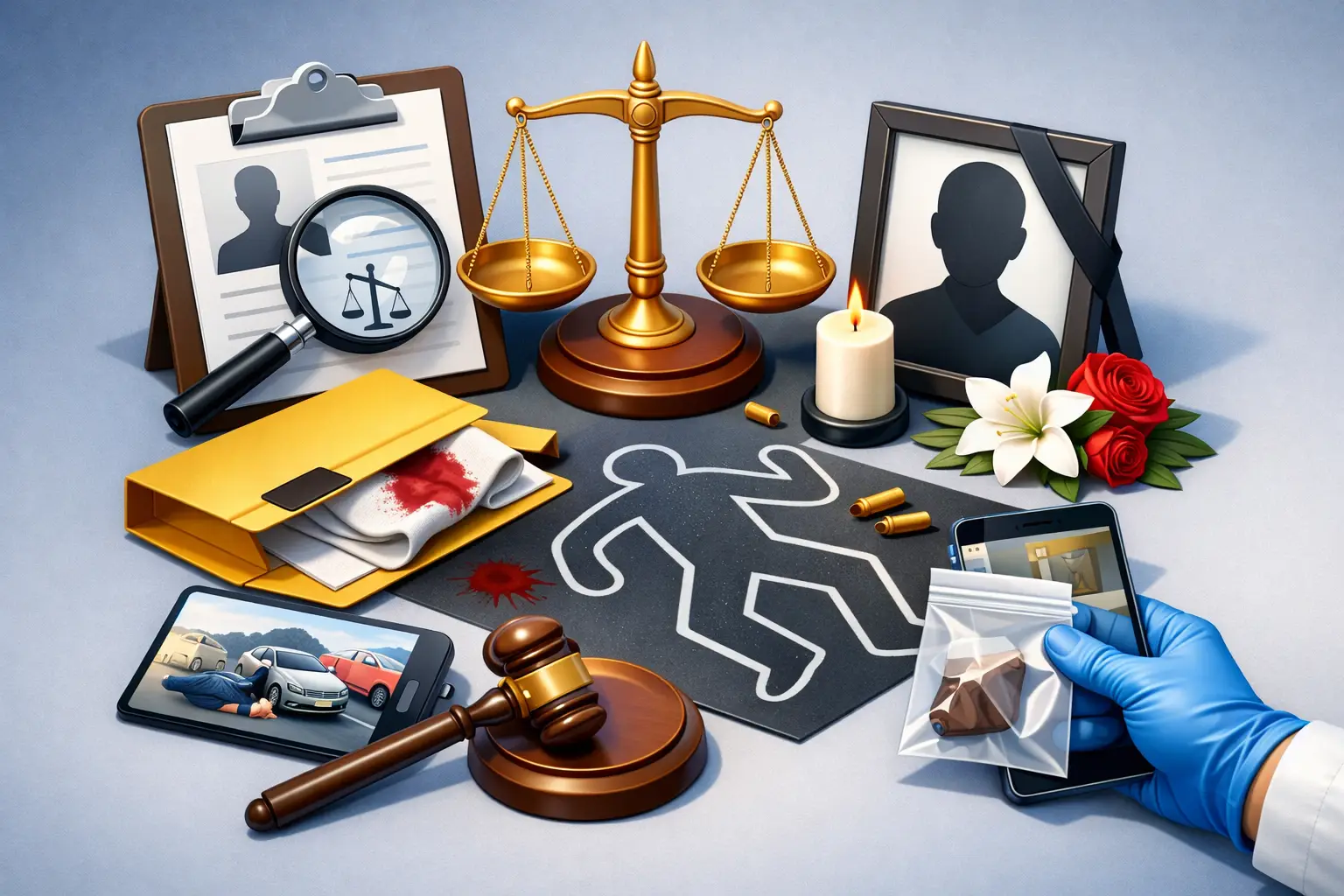
In motor vehicle and premises cases, the scene tells a story before lawyers ever argue about it. Police reports, photographs, body camera footage, vehicle damage, skid marks, surveillance video, and 911 recordings can show speed, visibility, road conditions, impact points, and what people said in the immediate aftermath.
This evidence is especially important because memories change. A witness who sounds certain at the scene may be less sure six months later. A business may erase surveillance footage on a routine schedule. A trucking company may not volunteer internal data unless it is pushed to preserve it. Fast action matters.
Witness statements
Witnesses do not just include strangers who saw the event. They may include coworkers, nurses, passengers, family members, first responders, and anyone who observed the decedent’s condition before or after the fatal incident.
Good witness evidence is specific. It answers who did what, when it happened, what warnings were present, how the person looked or behaved, and what changed afterward. Vague statements are less useful than detailed, consistent accounts.
Expert testimony
Many wrongful death cases rise or fall on expert analysis. Doctors, accident reconstructionists, economists, forensic pathologists, engineers, and life-care or vocational experts may all play a role depending on the facts.
Experts are often needed because juries and insurers want more than a theory. They want a qualified professional to explain how a surgical delay caused fatal complications, why a crash happened, whether a product failed, or how much financial support the family likely lost. In high-value litigation, expert selection is strategy, not a formality.
Financial and family-loss evidence
A wrongful death claim is not limited to the final event. It also addresses the real losses left behind. Pay stubs, tax returns, employment records, business income records, benefits information, and retirement data can help show what the deceased would likely have contributed.
But a life is not measured by wages alone. Testimony from spouses, children, relatives, and close friends may show the value of the person’s daily presence – childcare, household support, mentorship, emotional care, and the practical stability they brought to the family. That part of the case must be handled with care and credibility. Overstatement can hurt. Honest detail helps.
Why preservation matters so much
The best evidence often exists early and fades fast. A damaged vehicle gets repaired or sold. A phone gets wiped. Security footage is recorded over. Internal business emails disappear under retention policies. That is one reason trial lawyers move quickly to send preservation demands and identify what must be secured before it is lost.
Families should avoid guessing about what is important and keep more rather than less. Save photographs, text messages, voicemails, discharge papers, billing records, insurance correspondence, funeral records, social media screenshots, and names of potential witnesses. If there was a dangerous condition at a property or job site, document it as soon as it can be done safely.
There is also a judgment call here. Not every piece of information helps. Some material may be irrelevant, and some may be used by the defense to create confusion. That is where disciplined case review matters. Strong litigation is not just about collecting evidence. It is about knowing what proves the claim and what distracts from it.
Common defense arguments and the evidence that answers them
Insurance carriers and defense lawyers usually do not admit fault just because a death occurred. They look for alternate causes, shared fault, preexisting conditions, and gaps in the paper trail.
If the argument is that the deceased was responsible, crash data, eyewitness testimony, toxicology, and reconstruction evidence may become central. If the argument is that a medical condition would have caused death anyway, then prior records, treating physicians, and pathology evidence often become critical. If the argument is that the family’s losses are overstated, employment records and credible testimony usually matter more than emotion alone.
This is where courtroom readiness changes the value of a case. Evidence should be gathered with trial in mind, even if the case eventually settles. Cases built only for negotiation are easier to discount. Cases built to withstand cross-examination carry more weight.
What families should do now
If you believe a loved one died because of someone else’s negligence or misconduct, act before the evidence gets colder. Request the available reports. Keep every record. Write down your timeline while memories are fresh. Do not rely on an insurer to sort out the facts for you.
It is also wise to be careful with statements. Casual comments to insurance adjusters, public posts on social media, or incomplete retellings of the events can be taken out of context later. A wrongful death case is deeply personal, but it is still litigation. What you say and preserve can affect the outcome.
A serious law firm will look at the evidence through the lens that matters most – can this be proven under pressure, in front of a jury, against a prepared defense? That means identifying missing records, consulting the right experts, and building the case from day one as if it may have to be tried.
For families in Albuquerque and across New Mexico, that level of preparation is not a luxury. It is protection. If you need answers about whether the available proof supports a claim, request a free case review and get direct guidance before critical evidence disappears.
The right evidence does more than support a lawsuit. It gives a family the clearest possible account of what happened, and that clarity is often where the fight for justice begins.